
Product news roundup: features and products launched by AI visibility, GEO and SEO platforms in October and November 2026, from vendors' own changelogs and announcements.
In this story 6 sections +
Why it matters
- Profound launched Muse Spark tracking on 6 November and Prompt Analysis on 13 November 2026.[5]
- Scrunch announced Citation Optimization on 12 November, while Ahrefs added prompt topic analysis on 6 November.[1]
- Promptwatch launched sitemap content-gap features on 4 November and agency PDF reports on 13 November.[2]
- Semrush’s 13 October AI Visibility Index was research, not a new software feature release.[15]
- The reviewed launches prove that capabilities shipped, but they do not prove improved AI visibility or citation performance.[1]
Through 17 November 2026, the clearest AI visibility product launches included Profound’s Muse Spark tracking and Prompt Analysis, Scrunch’s Citation Optimization, Ahrefs’ prompt topic analysis, and Promptwatch’s sitemap content-gap and agency-report features.[1] These releases added new ways to monitor models, understand prompt coverage, investigate citation sources, and package AI visibility findings for clients; none of the announcements by itself proves improved visibility or citation performance.
What happened in October and November 2026?
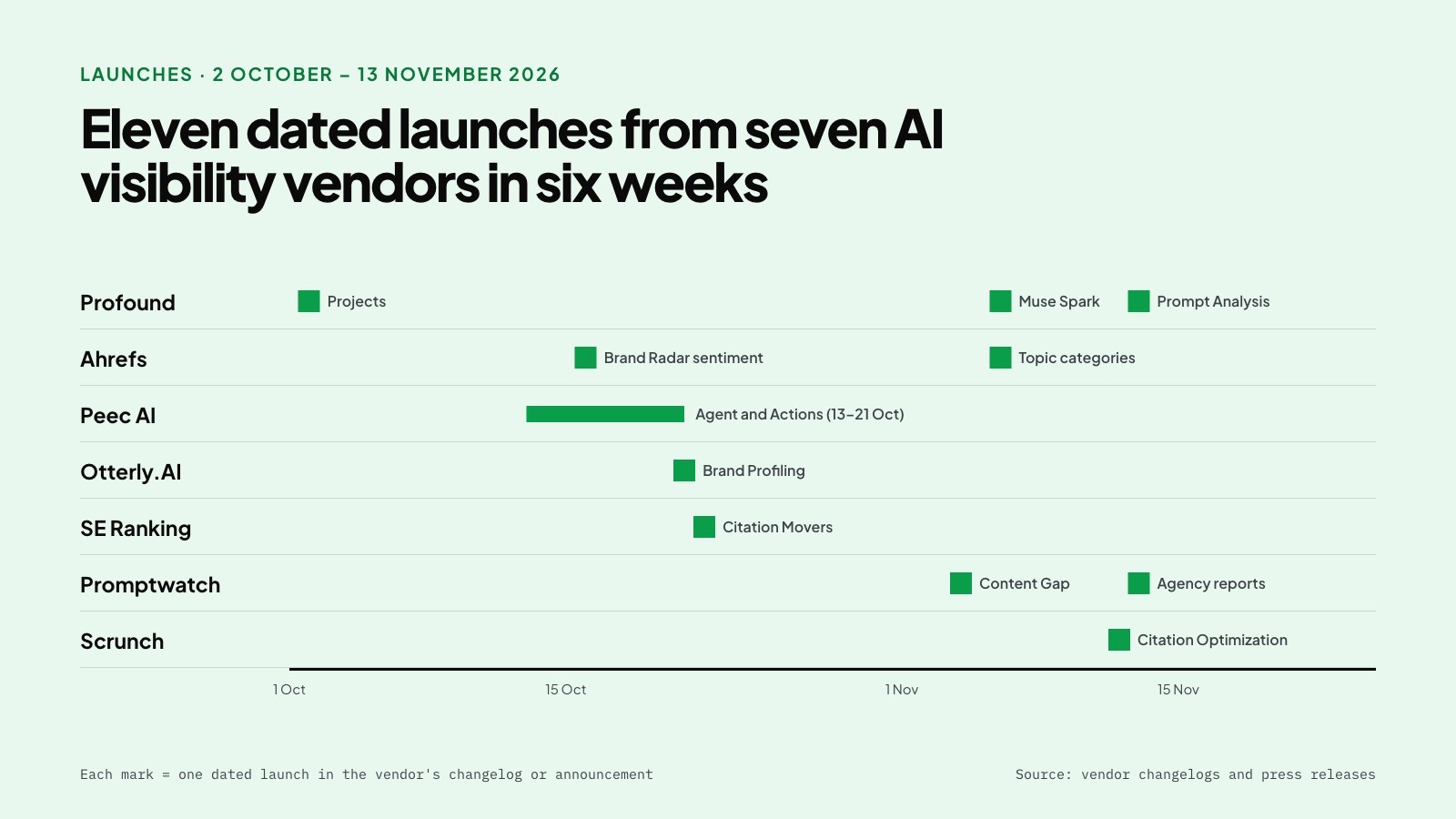
October releases focused mainly on diagnosis and workflow. Profound introduced Projects on 2 October, Peec announced Agent and Actions between 13 and 21 October, Otterly.AI released Brand Profiling on 21 October, Ahrefs added sentiment and search-intent analysis on 16 October, and SE Ranking introduced Citation Movers and Citation Types on 22 October.
November brought more focused analysis and action features. Profound made Muse Spark trackable on 6 November and launched Prompt Analysis on 13 November; Ahrefs added prompt topic analysis on 6 November; Promptwatch added sitemap-level AI Visibility and Content tabs on 4 November and agency PDF reports on 13 November; and Scrunch announced Citation Optimization on 12 November.[2]
| Vendor | Launch | Date | Source |
|---|---|---|---|
| Profound | New Projects for organizing initiatives, context, conversations, and outputs | 2 October 2026 | |
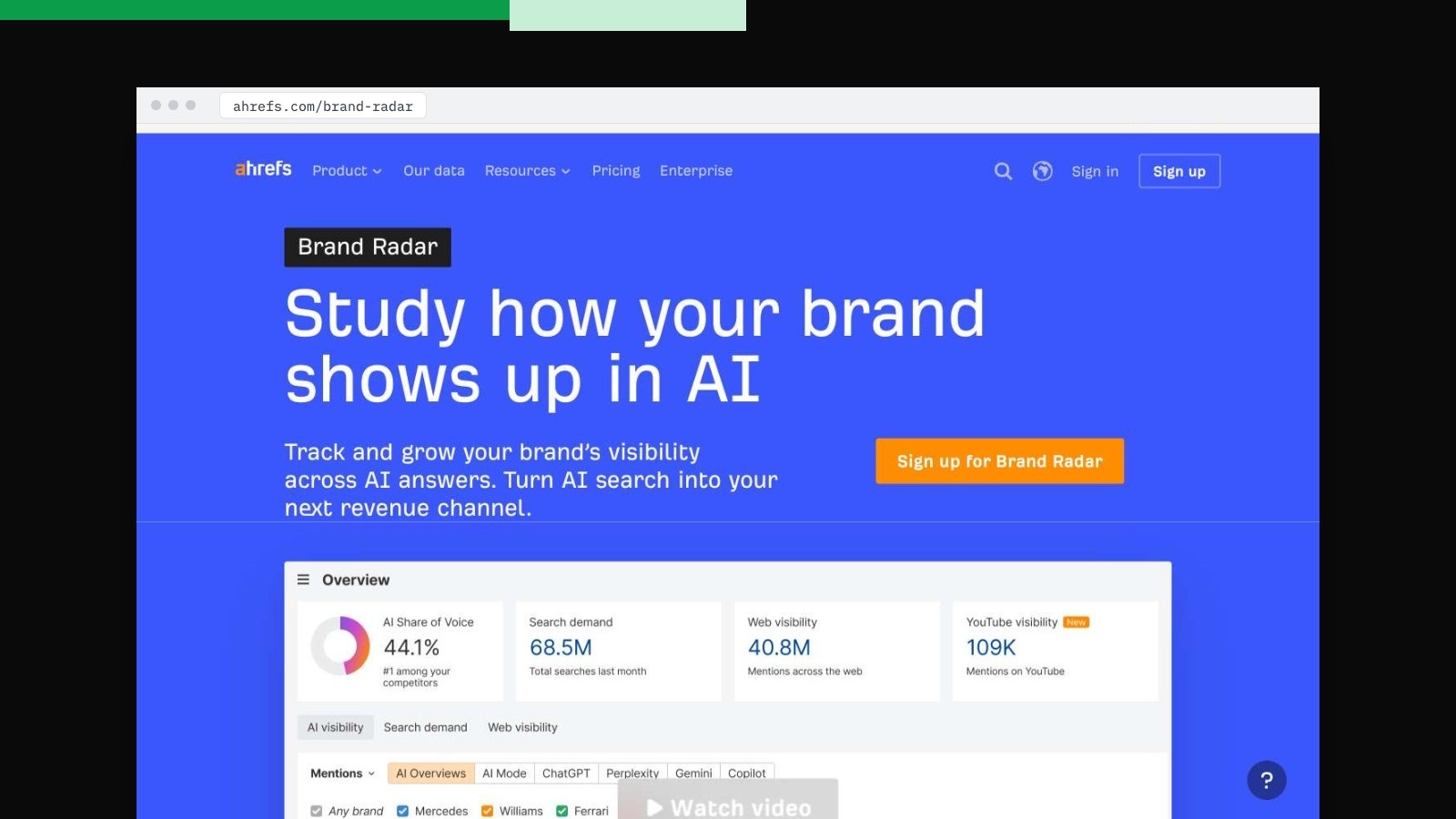
| Ahrefs | Sentiment analysis and search-intent/consideration-stage analysis in Brand Radar | 16 October 2026 | |
| Peec AI | Peec Agent and Actions, including content optimization | 13–21 October 2026 | |
| Otterly.AI | Brand Profiling for comparing how AI engines describe brands | 21 October 2026 | |
| SE Ranking | Citation Movers and Citation Types | 22 October 2026 | |
| Profound | Muse Spark tracking in Answer Engine Insights | 6 November 2026 | |
| Ahrefs | Brand Radar prompt analysis by topic category | 6 November 2026 | |
| Promptwatch | Sitemap AI Visibility and Content tabs, including Content Gap | 4 November 2026 | |
| Scrunch | Citation Optimization | 12 November 2026 | |
| Profound | Prompt Analysis and AI Marketer email access | 13 November 2026 | |
| Promptwatch | Agency PDF reports for AI visibility findings | 13 November 2026 |
Profound
Profound added Projects on 2 October 2026. The feature organizes marketing initiatives, context, conversations, and outputs; the announcement also described importing Granola meeting notes and a Salsify integration.[3]
On 6 November, Profound added Muse Spark 1.3 to Answer Engine Insights, making the model trackable in the product.[4] On 13 November, Prompt Analysis grouped prompts by buying stage, supported comparisons, and allowed users to filter unbranded prompts. The same release added the ability to email the AI Marketer.[5][6]
The October Project release is primarily a workspace and context feature, while the November releases address model coverage and prompt diagnosis.[2][3]
Peec AI
Peec announced Peec Agent and Actions between 13 and 21 October 2026.[7][8] The October material described content optimization for feature pages, articles, and listicles, along with agent assistance for project setup and prompt expansion.[8]
Peec’s 5 November changelog entry recapped October updates, including scheduled routines, team sharing and actions, site-performance views, and navigation changes.[7] The 5 November date is therefore a recap date rather than confirmed evidence that all of those capabilities first shipped in November.[9]
Otterly.AI
Otterly.AI introduced Brand Profiling on 21 October 2026. The feature shows how AI search engines describe a brand relative to competitors.[10]
On 10 November, Otterly’s Data/Looker Studio connector gained multi-selection aligned with Brand Reports.[10] Otterly also introduced pricing choices based on AI search engines and prompt volume while stating that plan prices remained the same.[10]
The November item is best described as a reporting and packaging update rather than a newly announced visibility-analysis category.
Scrunch
Scrunch announced Citation Optimization on 12 November 2026.[1] The feature identifies pages cited for tracked prompts, ranks potential sources to pursue, and checks brand mentions against approved internal sources.[11]
This makes Scrunch’s release distinct from a basic citation dashboard: its stated purpose is to connect observed citations and brand mentions with source-selection and validation workflows.[11]
Ahrefs
Ahrefs added sentiment analysis and search-intent or consideration-stage analysis to Brand Radar on 16 October 2026.[12] Its October update also described topic categories and redesigned views and reports.[10][3]
On 6 November, Ahrefs added prompt analysis by topic category. Prompts can receive up to three automatically assigned categories, and the feature compares topical mentions for a brand and its competitors.[11]
The sequence matters: October expanded brand-perception and intent diagnostics, while November moved analysis down to prompt topics.[5]
SE Ranking
SE Ranking introduced Citation Movers and Citation Types on 22 October 2026.[13] Citation Movers groups domains and URLs by citation gains and losses, while Citation Types classifies source types and formats and tracks their mix over time.[13]
No dated November feature release was identified in the reviewed SE Ranking material.[13] That should be reported as a limitation of the reviewed announcement record, not as evidence that no November development occurred.
Promptwatch
Promptwatch added sitemap-level AI Visibility and Content tabs on 4 November 2026.[2] Its Content Gap feature compares site pages with AI prompts, supplies a coverage score, and suggests actions.[2]
On 13 November, Promptwatch added agency PDF reports that summarize how AI platforms discuss a site, with customizable prompts and models.[14] These releases extend Promptwatch from site and prompt diagnosis into content planning and client-facing reporting.[2]
Semrush
Semrush released its 2026 AI Visibility Index on 13 October 2026.[15] The announcement included the company’s first UK benchmark and described analysis using 2.5 million UK prompts and 25 million US prompts.[15]
The AI Visibility Index was a research benchmark, not a newly shipped software feature.[15] No November AI-visibility software feature release was identified in the reviewed Semrush announcement material.[15]
AthenaHQ
No dated October or November 2026 product release was identified in the reviewed AthenaHQ official blog material.[16] A surfaced 12 November item concerned a ChatGPT ads guide rather than a product changelog entry.[16]
Why does each launch matter?
The releases fall into three practical groups: measurement and diagnosis, workflow and intervention, and research or reporting.
- Measurement and diagnosis: Ahrefs added sentiment, intent, and topic analysis; SE Ranking added citation movement and source-type analysis; and Otterly.AI added Brand Profiling.
- Workflow and intervention: Profound added Projects and Prompt Analysis, Peec added Agent and content optimization, Scrunch added Citation Optimization, and Promptwatch added content-gap and agency-report workflows.[1][8]
- Research and benchmarking: Semrush’s AI Visibility Index provides benchmark research but should not be counted as a feature launch.[15]
For a brand investigating prompt relevance, Ahrefs’ topic analysis and Profound’s Prompt Analysis are the most directly aligned releases in this set.[5] For a team investigating which external sources influence AI answers, Scrunch’s Citation Optimization and SE Ranking’s citation analysis address different parts of the source problem.[1] For agencies, Promptwatch’s PDF reports and Peec’s sharing and action workflows are the most directly client-oriented updates.[14]
The academic evidence supports separating shipped functionality from measured outcomes. A 2026 ACL paper on feature-level optimization for generative citation visibility reported that token-level GEO heuristics did not consistently improve citation visibility across all engines compared with an unmodified baseline.[9] A new dashboard, recommendation system, or optimization workflow therefore confirms that a capability was released, not that it caused higher citations or visibility.[13][10]
What is confirmed, and what is not?
The dated product capabilities above are supported by vendor changelogs, vendor announcements, or product-related announcements identified through 17 November 2026.[8]
The evidence does not establish that any release improved a customer’s visibility, citation rate, ranking, traffic, or revenue. The reviewed announcements describe capabilities and workflows rather than controlled before-and-after performance results.[9]
The timing of Peec’s updates also requires care. Its 5 November changelog entry described October updates, so it should not be presented as proof that those features launched on 5 November.[7]
Security announcements should likewise remain separate from product launches. Peec announced completion of a SOC 2 Type II examination on 30 October, covering controls assessed from 30 March through 30 June 2026.[17] Promptwatch’s October article reported ISO/IEC 27001:2022 certification first issued on 26 October 2026.[18] These are compliance announcements, not AI visibility feature releases.
Scrunch’s FAQ says it completed a SOC 2 Type II audit, but the reviewed FAQ does not date that completion.[19] Otterly.AI’s compliance page describes SOC 2 principles and lists a Type II audit as a roadmap item rather than reporting a completed in-period certification announcement.[20]
What should teams watch next?
The most useful way to evaluate these releases is to match the feature to the unresolved visibility question:
- If the problem is whether tracked prompts cover the buying journey, inspect Profound’s buying-stage grouping and Ahrefs’ topic categories.[5][9]
- If the problem is how AI systems describe the brand, compare Otterly.AI’s Brand Profiling with Ahrefs’ sentiment analysis.[10]
- If the problem is which sources influence answers, evaluate Scrunch’s source recommendations alongside SE Ranking’s citation movement and source-type analysis.[1]
- If the problem is turning findings into content work, assess Peec’s content optimization and Promptwatch’s Content Gap workflow.[8]
- If the output must be delivered to clients, compare Promptwatch’s agency PDF reports with the reporting and sharing workflows described by Peec.[14]
Background: what counts as an AI visibility product launch?
This roundup counts a dated vendor changelog entry, product announcement, or product-related announcement describing a new capability or materially expanded workflow between 1 October and 17 November 2026.[2][10]
It separates product features from research publications, security announcements, pricing changes, and undated compliance statements. Semrush’s AI Visibility Index is included for context but excluded from the feature-launch count because the announcement describes a benchmark rather than newly shipped software functionality.[15]
A launch date proves that the vendor announced or documented a capability by that date. It does not prove universal availability, customer adoption, performance improvement, or causal gains in AI visibility.[17][16]
Frequently asked questions
Which AI visibility features launched in November 2026?
The clearest November launches identified through 17 November were Profound’s Muse Spark tracking and Prompt Analysis, Ahrefs’ prompt topic analysis, Scrunch’s Citation Optimization, and Promptwatch’s sitemap and agency-report features.[1] The releases address model tracking, prompt analysis, citation-source discovery, content gaps, and client reporting.
Did Semrush launch a new AI visibility feature in November 2026?
No dated November AI-visibility software feature release was identified in the reviewed Semrush announcement material.[15] Semrush’s 13 October AI Visibility Index was a research benchmark, including a first UK benchmark, rather than a newly shipped product feature.[15]
What did Profound launch in November 2026?
Profound made Muse Spark 1.3 trackable in Answer Engine Insights on 6 November 2026.[4] On 13 November, it added Prompt Analysis by buying stage, comparisons, unbranded-prompt filtering, and email access to the AI Marketer.[5]
What did Ahrefs add to Brand Radar in November 2026?
On 6 November 2026, Ahrefs added prompt analysis by topic category. The feature assigns up to three categories automatically and compares topical mentions for a brand and its competitors.[11]
Did these launches prove that AI visibility improved?
No. The announcements document new capabilities, but they do not establish improved citation rates, rankings, traffic, or revenue.[12][11] A 2026 ACL paper also reported that token-level GEO heuristics did not consistently improve citation visibility across all engines, reinforcing the need to measure outcomes separately.[9]
Sources
- [1]Scrunch Launches Citation Optimization to Help Brands globenewswire.com
- [2]Changelog | Promptwatch promptwatch.com
- [3]Meet the new Projects, integrate more context, and more in Profound product.tryprofound.com
- [4]Track Muse Spark, admin allowlist for integrations, and more in Profound tryprofound.featurebase.app
- [5]Know the prompts to track with Prompt Analysis, email with your AI Marketer, and more in Profound product.tryprofound.com
- [6]New OtterlyAI Pricing: Same Price, More Prompts, Your Engines otterly.ai
- [7]Peec AI Changelog peec.ai
- [8]Turn opportunities into impact with Peec Agent and actions - Peec AI peec.ai
- [9]Think Before Writing: Feature-Level Multi-Objective Optimization for Generative Citation Visibility aclanthology.org
- [10]Changelog: What's New in OtterlyAI help.otterly.ai
- [11]Scrunch | Blog - Introducing Citation Optimization: Land the sources AI trusts, shut down the ones it shouldn’t scrunch.com
- [12]Sentimiento de marca en Brand Radar, Traffic Analytics y más (octubre 2026) ahrefs.com
- [13]SE Ranking on X: "⚡ New in SE Visible by SE Ranking: Movers and Types in Citations. Now you can see which sources AI is starting to cite more, and which ones it's quietly dropping, the same week it happens. Movers ranks domains and URLs by how fast they gain or lose AI citations: Top, New, Trendi… / X x.com
- [14]AI Visibility Reports for Agencies | Promptwatch Changelog promptwatch.com
- [15]Semrush Releases 2026 AI Visibility Index, Revealing Its First UK Benchmark semrush.com
- [16]Blog | Action on AI Search athenahq.ai
- [17]Peec AI Completes SOC 2 Type II Examination, Making Its AI globenewswire.com
- [18]AI Visibility Tools With ISO 27001 Certification: Which Platforms Are Certified (October 2026) | Promptwatch promptwatch.com
- [19]Scrunch | FAQs - Is Scrunch SOC 2 Type II compliant and what security standards does it meet? scrunch.com
- [20]Is OtterlyAI ISO-27001 or SOC-2 compliant? help.otterly.ai